The AI Paradox
Earth month is celebrated in April every year, and I couldn’t let the month end without addressing the elephant in the room - sustainability. While I have already written about multiple use-cases for AI and some of its benefits, I would be remiss if I didn’t talk about the threats. Can we even put AI and sustainability in the same sentence? Well, I’m going to attempt to. While I constantly think about the moral dilemma that comes with using AI in 2026, I’ve learned that there are some AI users who simply prefer not to know about the threats of AI at all. If that’s you, I would still encourage you to keep reading because there might be some information that you care about in this blog.
As tools like ChatGPT, Claude and the various Copilots become embedded in our daily workflows, the conversation is expanding beyond productivity to include sustainability. When I think about sustainability, I consider it from two lenses - environmental and social. So naturally, when I think about the impact of AI, our planet and people come to mind. There is no doubt that AI is transforming our society even if you personally aren’t onboard with it yet. So, in my opinion, we don’t have the luxury to be ignorant of the impact of something that’s currently reshaping our society. Let’s talk about the impacts of AI on people and the planet.
AI & The People
Winners & Losers
AI adoption has been accelerating at an unprecedented rate. According to the Organisation for Economic Co-operation and Development (OECD), approximately 20.2% of firms have adopted AI, more than doubling in the last two years. However, when we look beyond the companies themselves and assess people on an individual level, we see a deeper story. There are differences in income, education, and age that create significant gaps in who benefits from AI. For example, while there are many free versions of AI tools that exist, there are also paid versions which perform significantly better and offer more features. You can’t benefit from these features unless you’re a paying customer, and you can’t pay for them unless you have sufficient disposable income to do so. Hence, you don’t reap the benefits. Another example focusing on age and education is the case where certain generations of people who use technology (but are not quite tech savvy) are now exposed to scammers using advanced AI to take advantage of them. With limited global regulation and standards, unfortunately, our aging populations around the world will be increasingly susceptible to such sophisticated scams. Here is one man’s story about an unfortunate incident with AI: 76-year-old loses $1.6 million savings to AI investment scam. While there’s a lot of freedom to create and accomplish things with AI today, it’s also imperative that we consider proper governance to reduce inequalities and crime.
The Workforce Shift
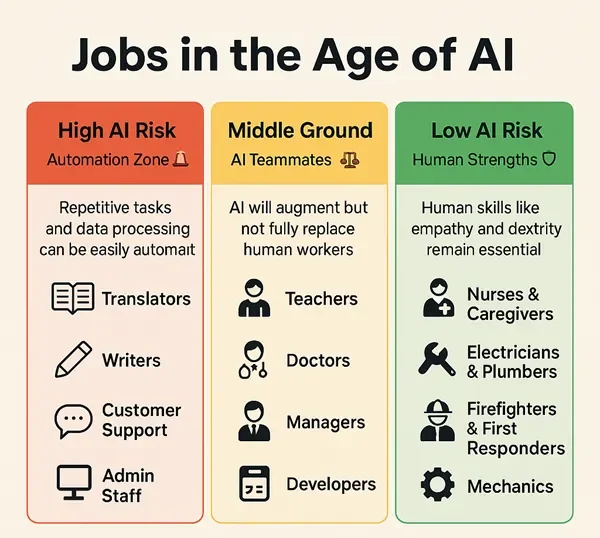
On another note, AI is also reshaping the labor market. The International Monetary Fund (IMF) estimates that AI could impact up to 40% of global jobs, particularly in advanced economies who have the resources and infrastructure to quickly advance in AI. While some roles will generally be enhanced, others may be replaced, raising concerns about workforce transitions and upskilling. What we’ve been seeing in the workforce so far is the automation of repetitive tasks; increased efficiency in sectors like logistics, finance, and healthcare; and the creation of new roles in AI development, data engineering, and governance. While some of this sounds exciting, reports from the World Bank highlight that AI could actually widen economic inequality because it appears that high-skilled workers benefit the most; routine and middle-skill jobs are at higher risk of automation; and developing economies may struggle to keep up with AI infrastructure demands. This places immense pressure on the global working class to sharpen their skills and try to learn new ones as soon as possible. The following graphic by InsyncNews.com and Computer Technologies, LLC indicates the types of careers that are currently considered to be at high risk, medium risk and low risk of being replaced by AI.
Ethics & Bias
Another social or human concern is that AI systems learn from data, and that data reflects human history, including its biases that we have been working so hard to dispel for generations. There are several ways in which bias can manifest in AI systems. Algorithmic bias can result indiscrimination in hiring, lending, and policing systems. Misinformation could be rampant due to AI-generated content sometimes hallucinating confidently. Privacy issues could be amplified with large-scale data collection from people who may not be aware of what they should and shouldn’t upload into AI systems. Behavioral influence is also a concern as algorithms shape what people see, think, and buy, putting us at risk of no longer making independent choices for ourselves. To combat this concern, organizations like UNESCO emphasize the importance of ethical AI frameworks to ensure fairness, transparency, and accountability. Additionally, Anthropic has recently been attempting to address ethical concerns with their “Constitutional AI” approach, by hosting private summits with religious leaders, theologians, academics and government officials to seek input on the moral, ethical, and spiritual development of their AI chatbot, Claude. Personally, I believe that ethics should have been addressed before releasing anything to the public, but some day I hope to see an improvement in all AI systems as it relates to the topics of ethics and bias.
We could go on and on about the impact of AI on humans, but despite all of this, one could still argue that AI has the potential to reduce some inequalities if used in the right ways. It could make people more productive which could increase their earning potential and it could make information more accessible to people who wouldn’t otherwise have it, which could decrease education gaps. People are using it to learn new languages, to keep abreast with curated news, to work alongside them when they experience creative blocks, and to upskill at a low cost. In fact, every time I speak to someone about how they use AI, I learn something new about how it has improved their quality of life. I am an advocate for using technology to improve the human condition. But while AI poses so many benefits, it still poses all the threats that I mentioned above. AI therefore plays a dual role as an equalizer and a divider and this is why it’s such a paradox.
AI & The Planet
If the previous section of this blog wasn’t interesting enough, I want to share some more information with you about how AI affects the environment.
Energy Usage
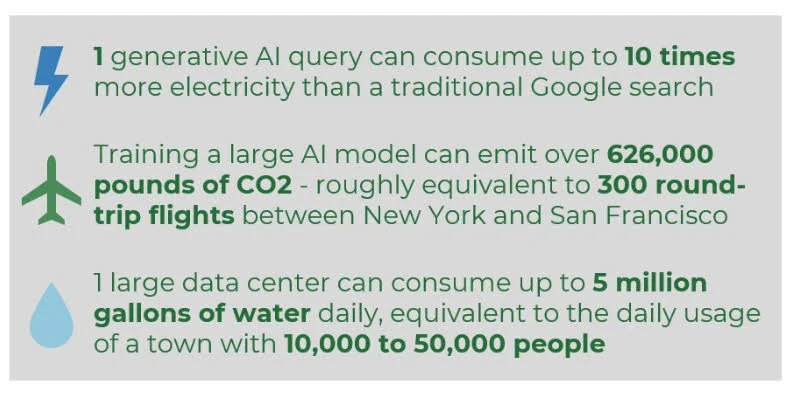
While AI reshapes society, it also places increasing pressure on our global energy systems. Data centers consume vast amounts of electricity and water for computing and cooling. Training and deploying AI models also requires immense computational power. According to the International Energy Agency, the data centers where AI workloads are processed already account for about 1% of global energy-related emissions. This might not seem like a lot, but AI has significantly scaled in a short period of time, and AI inference (everyday usage like prompts, recommendations, or image generation) runs continuously at massive scale. So as more companies embed AI into products, and as more people gain access to AI tools, the cumulative energy demand is rising rapidly. This unfortunately creates another paradox: the same technology helping to optimize industries, address climate change and reduce emissions in some existing use-cases is also increasing global electricity consumption and carbon dioxide emissions.
Water Usage
Additionally, cooling systems in data centers require significant water resources, and the carbon footprint of AI infrastructure continues to grow alongside demand. This has real-world consequences such as increased stress on local water supplies, greater impact in drought-prone regions, and competition with community and agricultural needs. Apart from electricity and water consumption, AI hardware also affects communities because building and maintaining this infrastructure requires raw materials (including rare earth metals), land and construction resources and a continuous energy supply.
Community Impact
When you consider all of these things, you’ll realize that the environmental cost of AI is substantial. Across the US and globally, communities near data centers are beginning to feel the impact through increased energy demand and environmental strain. In places like Archbald, residents are pushing back against data centers that strain land, water, and air resources, while projects in Michigan raise concerns about rising electricity costs. Regions in the Southern U.S. face increased fossil fuel use to power AI, and areas like Newton County are dealing with growing pressure on water systems. Meanwhile, Northern Virginia has seen large-scale energy and water consumption reshape local infrastructure. Together, these cases show that AI’s environmental footprint is localized, uneven, and often borne by communities that may not directly benefit from its growth.
E-Waste
Considering everything above, we need to acknowledge that the companies developing them have a huge responsibility as manufacturing the hardware generates significant emissions. Additionally, frequent upgrades driven by constant AI innovation shorten hardware lifespans and therefore, electronic waste continues to grow. This is ultimately a life cycle problem, but in the same way that manufacturers of consumer goods keep track of the life cycle of their raw materials in order to minimize environmental impact, manufacturers of AI hardware can also keep track and innovate to reduce their impact.
I’ve already written about how AI can help in the fight against climate change in another blog, but considering its sizable impact on the planet, I must acknowledge that there’s much work to be done to reach a net-positive impact. These adverse effects make it critical to evaluate not just what AI can do, but what it costs to run. We have to decide if it’s worth it and we can only do that if we know the whole story (i.e. the costs and the benefits).
Moving Forward: Responsible AI in a Data-Driven World
My personal opinion is that AI is not inherently good or bad. I think the magnitude of its impact comes from how it is used and how often it is used. It can be powerful for accelerating innovation, improving decision-making, and solving global challenges as it has done in the past. But we need to remember that it doesn’t just run on algorithms; it runs on energy, water, and physical infrastructure. As adoption accelerates, so does its footprint. Moreover, Without intentional use, proper governance and policy alignment, it can deepen inequality, threaten livelihoods and strain environmental resources. To me, AI is a paradox, but if we want a net-positive outcome, we have to harness the power of AI with environmental and social governance in mind.
For data professionals, this presents an opportunity for us to not only build AI systems responsibly, but to analyze, measure, and guide their impact as we go.
For business leaders and government officials, this presents an opportunity for you to be proactive with research and providing guidance rather than being reactive when AI is not stewarded well. There are many countries and companies that we can learn from, but I will share more about them in a subsequent blog.
The future of AI will not be defined solely by its capabilities, but by how responsibly we choose to use it. I’m not going to say that you shouldn’t use AI because to me, this is the same as saying that you shouldn’t use the internet, and we have already been using it for decades in less conspicuous ways, but I am going to caution you and say that you should be mindful of how you use it and how often you do. Its impact depends on key decisions being made today and the onus is on everyone to do their part - the developers, the users, and especially the policymakers.