With the rapid advancement of generative AI, agentic AI systems, and automated coding tools, many data professionals are asking the same question: Will AI replace me? As a data engineer I, too, have asked this question. However, I don’t think data engineers will be completely replaced. I think AI will transform the profession in ways that will reward those who adapt and challenge those who do not. To be honest, this isn’t even a prediction because AI is already transforming my role as a data engineer today.
Among other things, data engineers primarily write code, design data architectures, manage data quality, implement governance frameworks, optimize performance, and ensure that organizations can trust their data. Although some of these things can be done by AI, most of these responsibilities also require business context, critical thinking, judgment, and collaboration - areas where AI still struggles. AI excels at things like automating routine tasks, coding, suggesting pipeline improvements, writing documentation, and even identifying potential bugs. Therefore, tasks that usually take data engineers hours can now take minutes with the use of AI. It helps us to be more efficient at our jobs, but it cannot do everything.
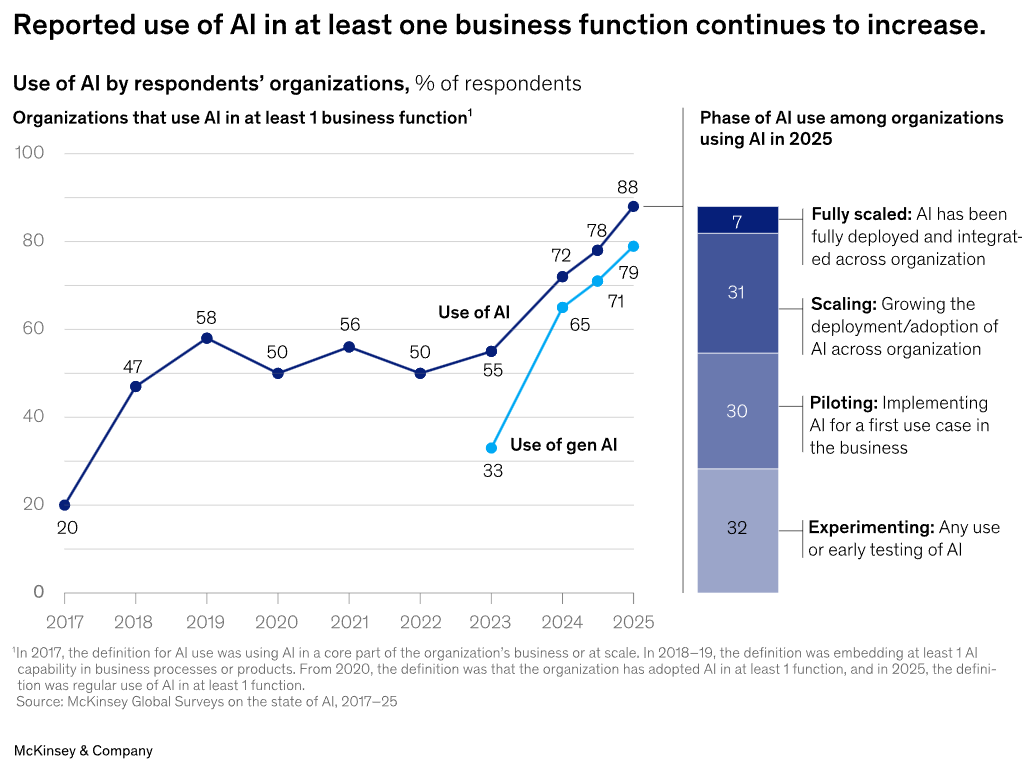
According to McKinsey's 2025 State of AI report, 88% of organizations now use AI in at least one business function, yet most are still struggling to scale AI initiatives because they cannot get past the experimentation phase. In many cases, this is due to the underlying data not being suitable enough for scalable initiatives which proves the point that AI models are only as good as their underlying data.
Gartner reports that over 60% of organizations either do not have, or are unsure if they have, the data management practices necessary to support AI in their organizations. Gartner further predicts that through 2026, organizations will abandon 60% of AI projects that lack AI-ready data. These findings reinforce a growing consensus across the industry: data quality, governance, and accessibility are becoming more important in the age of AI. These are responsibilities of data engineers. With this information in mind, I don’t think that the question should be whether AI will replace data engineers. The greater risk is that AI-enabled data engineers will replace those of us who fail to adapt. So what should we do to stay competitive?
1. Embrace Automation
In this era, data engineers should be learning how to leverage AI coding assistants, workflow automation tools, and intelligent monitoring systems to increase productivity and focus on higher-value work. In the last few years, I have been using different automation tools in my data pipelines and with the rise of AI, this just means that I have to learn new methods of automation, which I see as just another learning opportunity.
2. Become an Expert in Data Quality and Governance
As AI-generated content proliferates, trusted data becomes more valuable. Organizations need professionals who can establish data standards, security, and governance frameworks and more. These are all areas where data engineers can excel because it was already part of our job description.
3. Strengthen Business and Communication Skills
I’ve spent several years learning how to code in different languages, but now, AI can generate very good code. What this means for me and other data engineers is that we need to strengthen our other skills, especially business acumen. AI cannot navigate organizational politics, align stakeholders, define business requirements, or translate technical solutions into business outcomes like humans can. These interpersonal and business skills will become increasingly valuable to us in this era.
4. Move Closer to Strategic Decision-Making
In the AI-age, I think it’s imperative for data engineers to be able to connect data, technology, and business strategy. Understanding areas such as digital commerce, sustainability reporting, technology policy, customer analytics, and AI governance can differentiate us from purely technical practitioners.
Throughout history, we have seen that technology doesn’t always eliminate entire professions. Instead, it changes the skills that are valuable within those professions. Spreadsheets did not eliminate accountants. Cloud computing did not eliminate infrastructure professionals. Likewise, AI is unlikely to eliminate data engineers, but only time will tell. In an AI-driven world, we can’t afford to be resistant to change. Data engineers will find success if we go with the flow and evolve into data and AI leaders.